ENVIRONMENT
Core care conditions
Use these ranges as a starting point and adjust for life stage, enclosure ventilation and observed behaviour.
HUSBANDRY OVERVIEW
At a glance
- Taxonomic group
- Arachnida
- Origin
- Southeastern USA / Caribbean
- Lifestyle
- Arboreal / active hunter
- Adult size (body / total length)
- 1–2 cm
- Temperament
- Jumpy
- Experience level
- Beginner
- Visibility
- Very visible and active during the day
- Burrowing
- Does not burrow; builds silk hammocks
- Growth rate
- Fast
- Male lifespan
- 10–18 months total (often only living a few months to a year after their final mature molt)
- Female lifespan
- 1.5–3 years total (females consistently outlive males by a significant margin)
CARE NOTES
Keeping considerations
Provide top/side anchor points, foliage, cork bark, and cross-ventilation. Offer small flies, crickets, or roaches and maintain moderate humidity with a water droplet/misting routine rather than soaking the enclosure.
PRACTICAL HUSBANDRY
Day-to-day care
Diet & prey
Small flies (like bluebottles and fruit flies), pinhead crickets, small roaches, and small locusts
Feeding
Feed 2–3 times a week for juveniles (every 1–2 days) and once every 4–7 days for adults; offer prey roughly the size of the spider's abdomen.
Enclosure
Small arboreal enclosure (cube or vertical style, minimum 15 x 15 x 20 cm / 6 x 6 x 8 inches) with top/side anchor points and good cross ventilation.
Substrate
Coconut coir, peat-free topsoil, or paper towel (kept slightly damp at the bottom to maintain humidity, though they spend most of their time at the top).
Ventilation
Good cross-ventilation is essential to prevent stagnant air and mold growth, as jumping spiders are sensitive to stale, humid environments.
Hydration & misting
Mist one side of the enclosure walls lightly 2–3 times a week so the spider can drink water droplets directly from the glass.
Handling
Generally docile and curious toward humans, making them popular for gentle observation. However, they are extremely fast, agile jumpers and can easily escape or become startled, so direct handling should be kept to a minimum and done cautiously over a safe, enclosed surface.
Sex differences
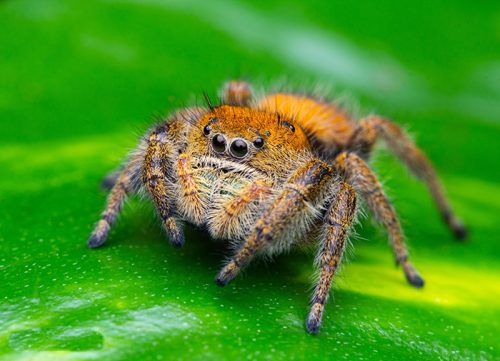
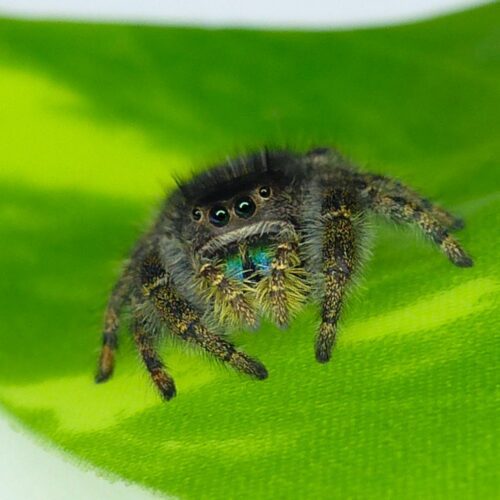
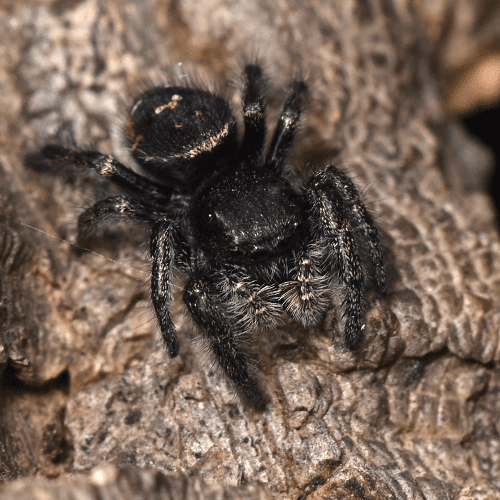
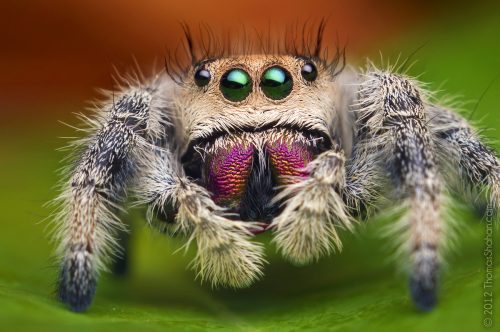
Adult males are smaller, slender, and distinctly black with bold white/black markings (or green/blue chelicerae). Adult females are noticeably larger, bulkier, and vary widely in color (shades of grey, tan, brown, orange, or white).
IMPORTANT CONSIDERATIONS
Keeper notes
Fast jumpers; take care during maintenance or feeding to prevent unexpected escapes. They have mild venom for subduing prey, but are generally docile toward humans.
CARE VIDEOS
Watch and learn
SOURCES & FURTHER READING
Check the references
Care can vary by species, life stage and local conditions. Review multiple reputable sources before making husbandry decisions.
KEEP EXPLORING
More Phidippus
Other completed care guides from the same scientific genus.